

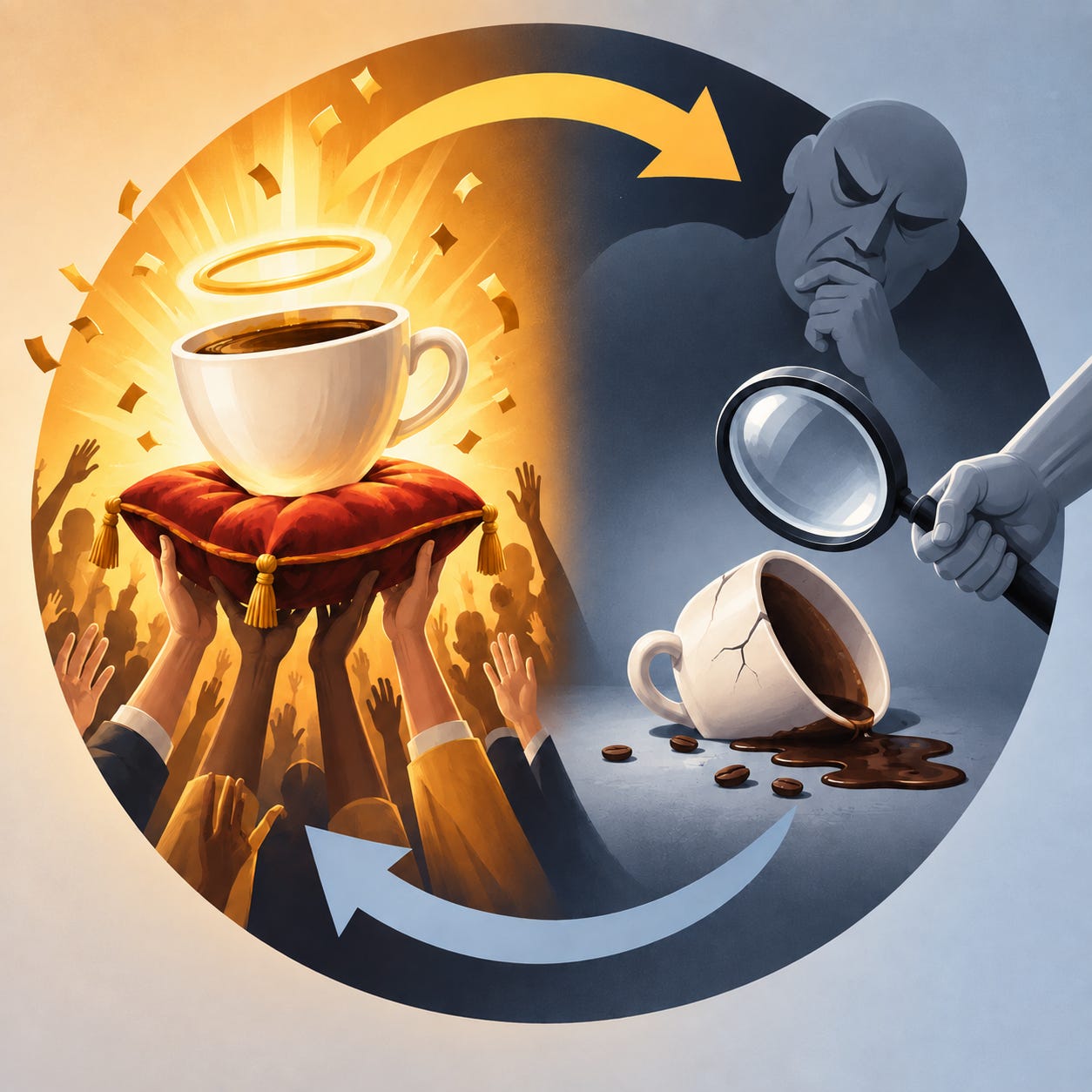
In a lecture transcript I recently saw, a scientist poked fun at media outlets for covering research in ways that suggest regular coffee-drinking bestows longevity. He pointed to the proclaimed links between three cups of coffee per day and longer life, expressing sincere doubt that his one cup that morning would make him live longer. The gist was that there’s no truth to any of this.
But there’s some truth to it. Large observational studies consistently find that drinking coffee is associated with better odds of enjoying a longer life. Associations don’t prove causation, but it’s also true that absence of evidence isn’t evidence of absence.
This post isn’t about coffee. It’s about the hype / hyper-skepticism cycle that takes up too much real estate in the health journalism landscape.
The Third Law of Wellness Discourse
Here’s how it works: In phase 1 of the cycle, mainstream media outlets report a study showing benefits of health behavior X. A headline trumpets a claim loosely based on the study. Post-click, the article (usually) clarifies the study’s limitations and more conservative conclusions in the actual write-up. Social influencers enthusiastically echo the spirit of the headline, omitting the buzz-kill details.
Phase 2: If the media coverage gets enough eyeballs and pick-up, it provokes a wave of hyper-skepticism, a backlash that treats the uncertain, inconclusive evidence as if it shows behavior X is probably worthless for health.
In Newtonian terms, we might call this phenomenon the Third Law of Wellness Discourse: for every exaggerated health claim, there’s an equal and opposite contrarian overreach.
The hype / hyper-skepticism cycle repeats with regularity across many areas of research. It’s often followed by reverberations in which the enthusiasts and skeptics take increasingly flagging punches at each other, like boxers fatigued in the final rounds, before another study makes headlines, renewing their pugilistic vigor.
Another example: Intermittent fasting
Intermittent fasting is another classic example. When a study comes out showing potential benefits, it’s reported with headlines suggesting we’ve uncovered a metabolic cure-all and lifespan extender. That leads to a predictable orgy of debunking.
We have no definitive evidence that any one approach to intermittent fasting, say a 16:8 schedule, improves health or longevity. Some studies show intermittent fasting makes no difference. But what’s lost in most reporting is that this diet is complex and takes many forms, each with their own tradeoffs, and individual factors like obesity probably lead to different effects. Several studies find benefits specifically in middle-aged people.
Existing research doesn’t justify everyone embracing intermittent fasting. But the right response isn’t to criticize the wellness hype with equally overblown skepticism in the name of protecting the public. It’s better to advocate reserved judgment until we have more research on various types of intermittent fasting in different groups. In the meantime, you could try intermittent fasting in the form that, based on research, seems to benefit the groups most like you, and see if it helps. Unless you’re fasting for very long periods, there is very little to no risk.
The nuanced response isn’t as fun as roasting media click-bait and wellness influencers. Maybe it’s also frustrating. We want science to be actionable—for the latest study to paint a black and white picture, telling us to do something or not do it. But that level of confidence takes many years and even decades of studies and scientific consensus-building.
Skeptics need to make a living, too
We tend to mistake skepticism for neutrality because it sounds like restraint and rigor. But there’s reason for caution on both sides of the hype / anti-hype cycle. Skeptics can cherry-pick and overstate certainty just as much as the people making the original health claim.
As wellness pontificators occupy more of the media and social-media landscape, the parallel culture of health skepticism has formed a large and aggressive defensive line. Pew has identified nearly 7,000 prominent health influencers; about 4 in 10 Americans get their health information from influencers or podcasts. Much of this information is wrong. There’s a clear and important role for debunking.
But these trends also create a market for debunking. A growing segment of doctors, researchers and science communicators are now devoted to dispelling health claims. Just like anyone else in the media ecosystem, skeptics have careers, public platforms and egos. Even if they’re not hawking pills, detox foot pads or grounding sheets, they have something to sell you: their brand of skepticism. Such skeptics may be just as invested as their wellness-hyping counterparts.
They have to capture attention to get clicks, reach audiences and secure speaking gigs and book contracts. They must play by the same rules as anyone else in the competitive media ecosystem. Rule #1: bold take-downs perform much better than nuance and balance.
Independent creators successfully monetize skepticism by framing it as a trustworthy antidote to mainstream health hype. I ran this idea by James Smoliga, a professor at Tufts School of Medicine who writes about health research and how it’s covered at his Substack, Beyond the Abstract. “Some of the big name skeptics are incentivized because hot takes on wellness claims do bring attention and money,” Smoliga said over email.
Though we didn’t get into any specific examples, there are many. Dr. Jen Gunter leveraged her viral, aggressive debunking of Goop's wellness claims to launch The Vajenda, a top-grossing Substack that monetizes medical skepticism from a dedicated base of paying readers.
Beyond Substack, institutional researchers and doctors can scale their skepticism into traditional media franchises. Take health policy expert Timothy Caulfield: the commercial success of packaging skepticism as an accessible trade book led to a lucrative career hosting a tv docuseries and gigs on the keynote circuit. Or consider Maintenance Phase, a podcast dedicated to dismantling diet culture and wellness fads. It’s cultivated a massive, paying audience, ranking among Patreon’s top earners, well over $100,000 per month.
None of this means we should ignore skeptics. Many of them offer great value, and incentives don’t prove bias. But we shouldn’t exempt them from scrutiny just because their rhetorical posture sounds more scientific.
The logic behind that posture is itself worth questioning. People who brand themselves as skeptics often try to align their approach with the scientific method, offering the rationale that skepticism is essential in science. But scientific skepticism is not about reflexively rejecting health claims. It’s about being skeptical of your own hypothesis, whether the hypothesis is that something is beneficial, harmful or does nothing at all.
Smoliga has a suggestion to differentiate a skeptic influencer from someone more balanced: their willingness to update their position as new evidence becomes available. You’re less likely to see this evolution from skeptic influencers. “For an influencer, doing so is an admission that their first take was wrong, which isn’t good for one’s ego—and followers may not like it, either,” Smoliga said.
In the end, the answer isn’t blindly subscribing to health claims or building a platform consisting of nothing but attacks on these claims. The answer in science, journalism and reading journalistic articles is to hold every claim—including skeptical ones—to the same unforgiving light.
Holding the skeptics to the same standard is so important, Matt! Willingness to update is a simple test, and I love it.
Your article would have been strengthened had you provided any examples of Gutner or Caufield being wrong about anything or anyone saying their views are “exempt from scrutiny.”
No one says such things. It’s a straw man.